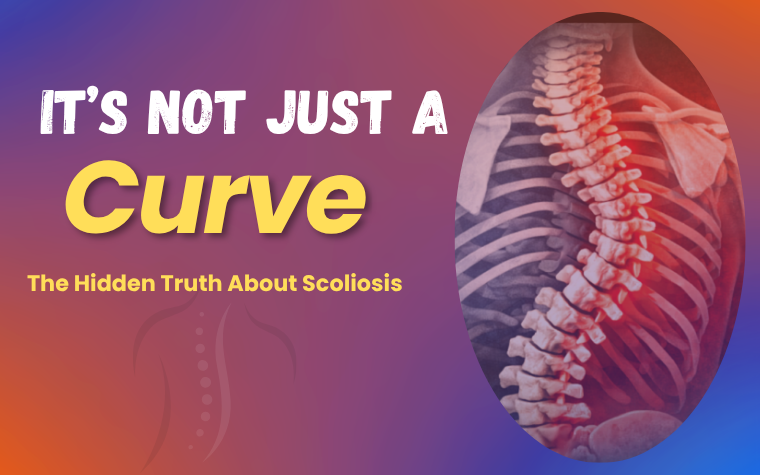
Scoliosis Isn’t Just a Curve – It’s a Whole-Body

Imbalance
Most people think scoliosis is just a sideways curve in the spine.
But in reality, scoliosis is a complex 3D biomechanical disorder that affects:
- Spine alignment
- Muscle balance
- Breathing mechanics
- Nervous system coordination
Treating only the curve is not enough.
The goal is functional correction + long-term stability.
The Hidden Problem Why Traditional Approaches Fall Short
Many treatments focus only on:
- X-ray angles
- Visible curvature
But they ignore:
- Muscle asymmetry
- Movement dysfunction
- Core instability
This is why some patients:
- Continue to have pain even after treatment
- Experience progression despite “monitoring”
Scoliosis is not just structural it’s functional.
The Shift in Modern Care – From “Correction” to “Control”
Advanced scoliosis care today focuses on 3 key goals:
1. Curve Control (Not Just Reduction)
- Prevent progression
- Stabilize spine during growth
2. Neuromuscular Re-education
- Train the brain & muscles to support alignment
- Improve movement patterns
3. Functional Symmetry
- Balance both sides of the body
- Restore natural posture
Advanced Non-Surgical Strategies (Game-Changer Approach)
1. 3D Scoliosis-Specific Rehabilitation
Unlike general physiotherapy:
- Exercises are curve-specific
- Focus on spinal rotation + alignment
- Integrate breathing + posture
This is where real correction begins.
2. Rotational Breathing Therapy
One of the most ignored aspects.
Scoliosis compresses one side of the chest reduces lung expansion.
Advanced therapy:
- Expands collapsed areas
- Improves oxygen capacity
- Supports spine correction internally
3.Dynamic Bracing (Next-Gen Orthotics)
Not old rigid braces.
Modern braces:
- Adapt to movement
- Guide growth in children
- Improve compliance (more wearable)
The Real Risk – What Happens If You Ignore Functional Scoliosis?
Beyond appearance, untreated scoliosis can lead to:
- Early disc degeneration
- Chronic muscular fatigue
- Reduced stamina
- Postural collapse with age
The impact is progressive and cumulative.
The Most Overlooked Factor – Daily Movement Habits
Even the best treatment can fail if daily habits are wrong.
What Actually Matters:
- Sitting posture (especially students & desk workers)
- Sleeping alignment
- Load distribution (bags, weight lifting)
Scoliosis is influenced 8–10 hours daily by your habits.
Conclusion – Treat Function, Not Just the Curve
Scoliosis management today is not about forcing the spine straight.
It’s about:
✔ Restoring balance
✔ Improving function
✔ Preventing long-term damage
At MGM Medical Center, the focus is precision, personalization, and performance of the spine.