


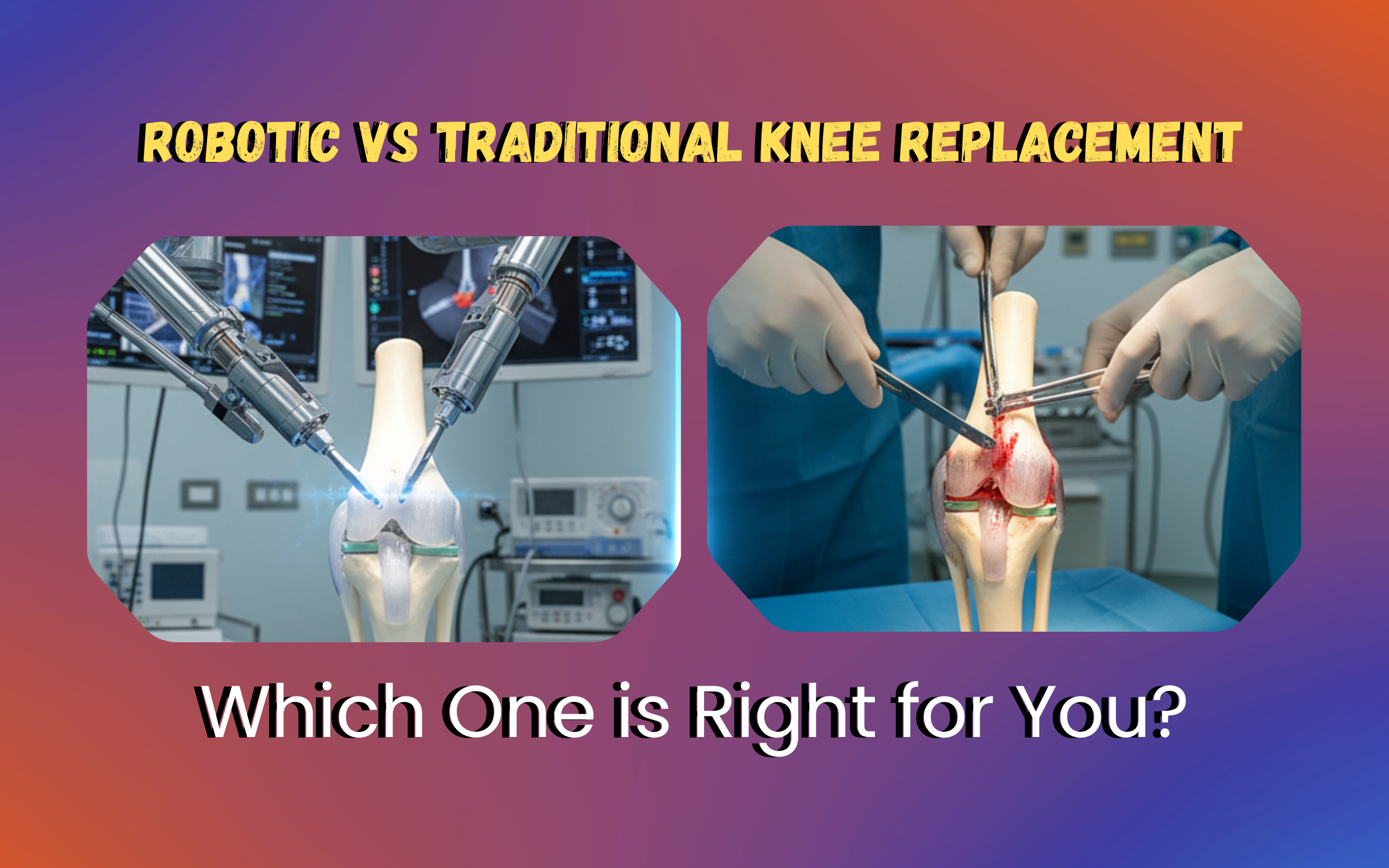
Robotic vs Traditional Knee Replacement: Which One is Right for You?

Knee pain can make even simple movements like walking or climbing stairs difficult.
When medications, therapy, or lifestyle changes no longer help, knee replacement surgery becomes an option. Over the years, medical technology has advanced greatly, and today, patients can choose between traditional knee replacement and robotic joint replacement. But which one is right for you?
Let’s explore both options, their benefits, and what you should consider before making your decision.
Understanding Knee Replacement
Knee replacement surgery, also known as knee arthroplasty, is a procedure where a damaged or worn-out knee joint is replaced with an artificial one. This treatment is often recommended for people suffering from severe arthritis, injuries, or other knee conditions that limit mobility and cause chronic pain.
The goal of a knee replacement is simple: to reduce pain, improve movement, and restore the ability to perform everyday activities comfortably.
There are two major approaches to this procedure:
- Traditional Knee Replacement
- Robotic Joint Replacement
Traditional Knee Replacement: The Classic Approach
How It Works
Traditional knee replacement has been performed for decades with excellent results.
In this method, the surgeon uses manual instruments to remove the damaged bone and cartilage from the knee and then positions the artificial implant by hand.
The surgeon makes an incision at the front of the knee, exposes the joint, and removes the damaged surfaces. Using visual judgment and manual guides, the surgeon then fits the artificial components precisely to restore alignment and balance.
Advantages
- Proven success rate: A long history of successful outcomes.
- Widely available: Most orthopedic centers offer it.
- Cost-effective: Typically less expensive than robotic-assisted options.
Limitations
- Less precision due to reliance on manual techniques.
- Longer recovery time.
- Possible variation in implant placement.
Robotic Joint Replacement: The Modern Evolution
How It Works
Robotic joint replacement is an advanced, technology-assisted version of knee replacement. A 3D digital model of your knee is created using CT scans, allowing precise surgical planning. During surgery, the robotic arm guides the surgeon to make accurate cuts and place the implant with exceptional precision.
Advantages
- Higher precision in implant placement.
- Less tissue damage and quicker recovery.
- Personalized results tailored to your anatomy.
- Faster recovery and reduced postoperative pain.
- Better long-term durability due to accurate alignment.
Limitations
- Higher cost due to advanced technology.
- Limited availability in some hospitals.
- Longer setup and planning time.
Key Differences Between Robotic and Traditional Knee Replacement
| Feature | Traditional Knee Replacement | Robotic Joint Replacement |
|---|---|---|
| Precision | Manual, based on surgeon’s experience | Computer-guided with millimeter accuracy |
| Planning | Based on X-rays and surgeon judgment | 3D CT scan and digital planning |
| Customization | Standard sizing and alignment | Personalized implant positioning |
| Recovery Time | Longer, may involve more pain | Faster, with less discomfort |
| Cost | More affordable | Higher due to technology |
| Availability | Widely available | Limited to advanced centers |
Who Is the Right Candidate for Each?
Traditional Knee Replacement May Be Better If:
- You have severe knee damage but are not concerned about advanced technology.
- You prefer a more affordable option.
- You live where robotic systems are not available.
Robotic Joint Replacement May Be Better If:
- You are younger or more active and want faster recovery.
- You prefer a customized and highly precise procedure.
- You want better accuracy for long-term outcomes.
Recovery After Knee Replacement
Regardless of the method chosen:
- Physiotherapy typically starts within 1–2 days after surgery.
- Most patients can walk with support within a few days.
- Full recovery usually takes 6–12 weeks depending on overall health and progress.
The Future of Knee Replacement Surgery
With continuous improvements in medical technology, robotic joint replacement is becoming more common. It provides enhanced visualization and precision during surgery, contributing to improved outcomes. Still, surgeon expertise remains the single most important factor in success.
Making the Right Choice
Both approaches have advantages: Traditional surgery offers reliability and affordability, while robotic-assisted surgery provides precision and faster recovery. The best choice depends on your medical condition, preferences, and your surgeon’s recommendation.
Conclusion
Knee replacement surgery can dramatically improve quality of life by restoring mobility and reducing pain.
As robotic technology continues to evolve, patients now have more options than ever.
While robotic joint replacement offers advanced precision, traditional knee replacement remains a trusted and effective choice.
Ultimately, the right procedure is the one that best aligns with your needs, lifestyle, and expectations, guided by a skilled orthopedic surgeon.